Loretta's Rondella
If you have a look at what I cook, you will see that it is pretty varied. Vegetarian, but varied. As one says in Spanish, algo bueno debía de tener. I often cook Chinese and Indian, at least what passes for that chez moi. Often Middle Eastern, sometimes Persian. As I said before, it is my firm belief that God has sent us a new prophet, this time not as a carpenter but rather as a cook: Ottolenghi.
I sometimes cook Spanish, but mostly during the summer. In any case, I go through different phases, depending on my most recent crush. At some point, my mother visited, and we only ate cauliflower for a week. In many different ways, but only cauliflower. After a phase of intense infatuation, I get over crushes, but the embers remain, and we still eat a lot of cauliflower.
Anyways, there are all signs that I am entering an Italian phase. My daughter is pushing for it. I guess she understands that more pasta means less curry. I have at least a decent list of dishes I want to try.
Evidently, there is sophisticated food in Italy, like elsewhere, but what I want to learn to cook is the pretty basic stuff: things like orecchiette con cime di rapa, fusilli con cavolo nero, ravioli con burro e salvia, or ribollita. These are absolutely delicious dishes needing very few ingredients. The only slightly more complicated dish (maybe) is ragù di seppia with some to-be-determined pasta—I had it with manfettini, but I gather that quite a few other pasta shapes will do as well. I guess this is what I can claim once back in Bretagne, for from the Italian pasta inquisition.
What might be a bit of a challenge is getting the ingredients. Not the cuttlefish, but rather the weirder vegetables they use. In Rennes, there are turnips (rapa), but I don’t think I have ever seen the greens (cime di rapa) sold on their own. I’m actually not sure that the turnip greens come from the same plant that produces turnips. There is more hope of getting cavolo nero—some sort of kale—but I’m afraid of getting the wrong kind of kale and ending up with something inedible. The plan is to try to grow these things in the garden—seeds came back with us—hoping that the Breton snails won’t have a taste for them. Plan B, to be run in parallel, is to try to find some other sufficiently basic recipes that use easier-to-find vegetables. Recipes for simple pasta dishes that, on the plate, just look like cream (the pasta) and dark green, with grated hard cheese on top.
Finding the recipes might also be a bit of a problem. The issue is that if you look for recipes for ribollita in English, you get something that looks much more colorful and pretty than the real deal. But it’s hard to believe that more colorful looks can make it any better. The incredible simplicity is what makes ribollita so good. At least in my eyes. In any case, true Tuscans will consider it heresy if I call ribollita anything I make. I might call it borlita instead, just to keep everyone happy.
I also want to learn to make fresh pasta. Okay, I have made fresh pasta before, but not often enough to know how to make it. The dream is to make ravioli—filled with spinach and ricotta—with butter and sage. To be able to make them so that it’s not something exceptional. Anyways, I will have to figure out how to deal with the ricotta, because the one in France is completely different from the one in Italy, much more liquid. And it seems that anyone who speaks about making pasta keeps speaking of umidità.
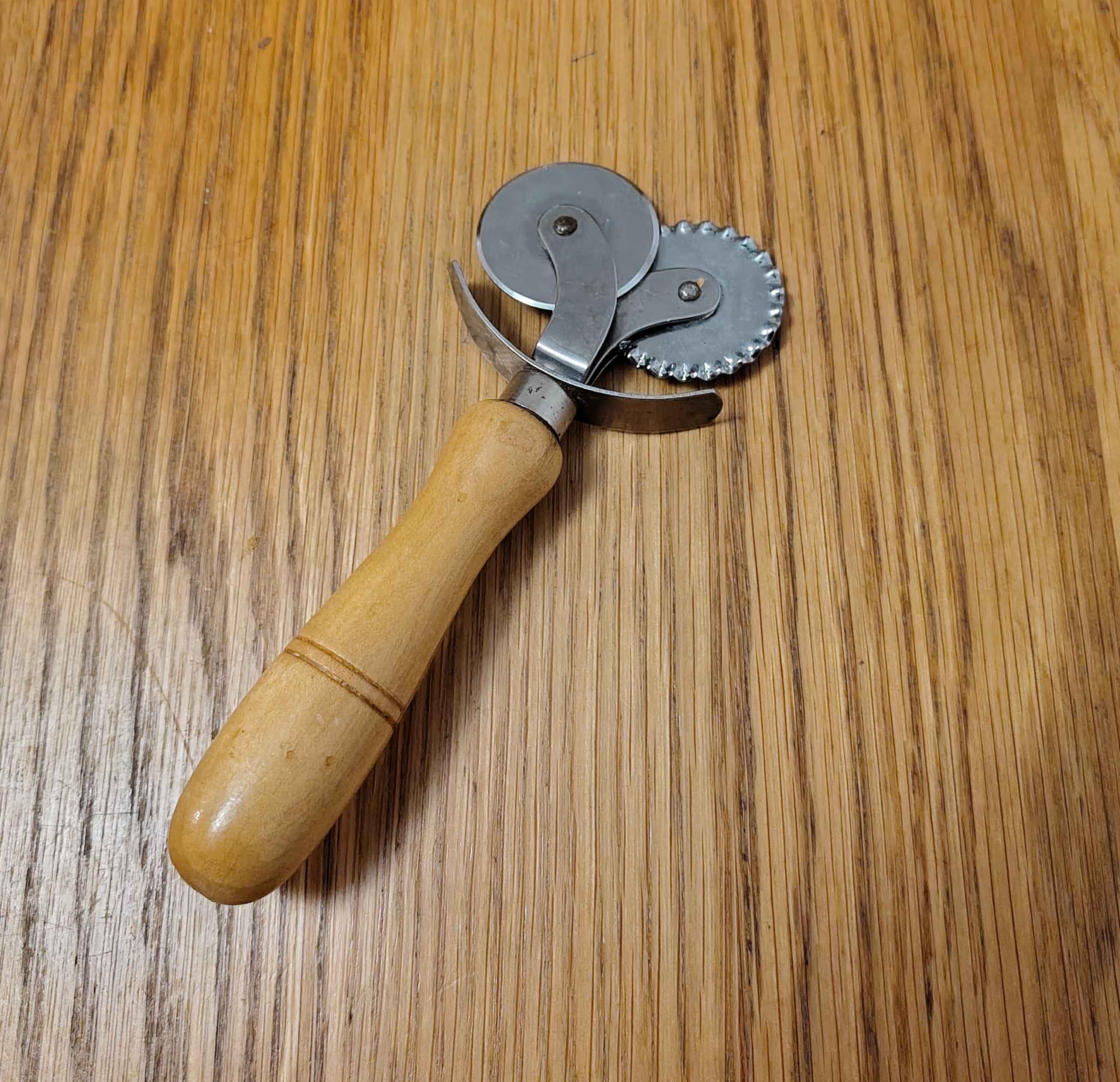
Loretta, my sister’s mother-in-law, the mother of that modern saint named after all the evangelists, recommended the YouTube channel of Alessandra Spisni, a cook and pasta-making teacher from Bologna. Evidently, it’s in Italian. I don’t speak Italian, but for reasons unknown to me, I understand it pretty well. Let’s see how much I understand of Alessandra’s explanations. In any case, Loretta taught the being how to make tagliatelle, and I think that the latter is ready to teach me—Dios nos coja confesaos. Besides, as a parting gift, Loretta gave me her rondella, pictured above. She was probably moved by the élan with which I sang Romagna mia. Really loud. Besides, she just uses the knife and seems to think that any other tool is only worthy of completely useless—but very loud—guys like me. In any case, armed with la vera rondella romagnola, I am sure that I will master the art of making pasta. Okay, let’s be realistic: I am sure that I am going to do it a few times, until I get into the next thing. In two weeks, I am going to Leipzig.